Maroon Bells — Snowmass Lake (above 10,800') Permit
Maroon Bells-Snowmass Wilderness · Colorado
Overnight permit for Snowmass Lake (above 10,800') in Maroon Bells-Snowmass Wilderness, booked as a dispersed camping zone.
Get an alert when a night opens on your Snowmass Lake (above 10,800') dates.
70% of the openings our scanner caught on Snowmass Lake (above 10,800') were gone within 10 minutes.
Snowmass Lake (above 10,800') reservation dates
- Season
- July (USFS names July-September as the best time to visit) to September
- daily quota
- 13groups
- max group size
- 10people
How to get a Snowmass Lake (above 10,800') permit
As of September 2026, Snowmass Lake (above 10,800') in Maroon Bells-Snowmass Wilderness, Colorado requires a permit issued via reservation. Snowmass Lake (above 10,800') is a high-demand permit, rating 7/10 on PermitSnag's demand index. Cancelled Snowmass Lake (above 10,800') permits are re-released on the booking system, and PermitSnag alerts you the moment one opens. The permit season for Snowmass Lake (above 10,800') runs July (USFS names July-September as the best time to visit) through September.
- Type
- Overnight
- Location
- Elk Range, White River National Forest, Colorado, CO
Step 1: Create a U.S. Forest Service account
Sign up at U.S. Forest Service if you don't have an account. Have your payment info ready.
Step 2: Know the release schedule
Permits release on a rolling basis. Check the release time for your dates.
Step 3: Be ready when permits drop
Log in a few minutes early. Have your dates, group size, and payment ready to go.
Step 4: Monitor for cancellations
If your dates are sold out, people cancel all the time. Set up PermitSnag alerts to catch openings instantly.
Snowmass Lake (above 10,800') pro tips
- Reserve a spot in the zone for every night of the trip. The permit is per zone per night, not per trip
- Permits are capped at two per person per calendar year, so do not burn one on a date you are unsure about
- Permits cannot be booked into a future release window: a trip that spans a month boundary has to wait for the later month to open
- If you are starting from the Maroon Scenic Area you also need a separate parking or bus reservation. The confirmation email links to it, and parking spaces are limited
- Once the permit is printed it cannot be changed or cancelled, so print it late
- Only two of the thirteen Snowmass Lake permits are sized 5-10 people, so a big group has one narrow target
More on Snowmass Lake (above 10,800'): Live availability activityWhen Snowmass Lake (above 10,800') permits open up
How much a Snowmass Lake (above 10,800') permit costs
Snowmass Lake (above 10,800') permit fee: $10 per person, per night from May 1 to October 31 (children 16 and under free), plus a $6 non-refundable reservation fee.
The Snowmass Lake (above 10,800') hike
- Route Type
- Out & Back
- Duration
- 1-7 nights
- Difficulty
- Strenuous
Snowmass Lake (above 10,800') landmarks
- 1Snowmass Lake
USFS zone quota: 13 groups a night (11 permits for 1-4 people and 2 for 5-10). Campfires prohibited; the lake sits above the 10,800-foot fire ban line.
Thirteen groups a night, the largest zone allocation in the Maroon Bells-Snowmass Wilderness, and no campfire, because the lake sits above 10,800 feet.
About this permit
Snowmass Lake is an Overnight Permit Zone in the Maroon Bells-Snowmass Wilderness with a quota of 13 groups per night, the largest allocation of any zone. USFS breaks it down as 11 permits for 1-4 people and 2 permits for 5-10 people.
Unlike Conundrum Hot Springs, Crater Lake and Capitol Lake, this zone does not assign campsites. USFS asks you to select a campsite within the zone that is already established and is 70 big steps away from trails and water. What the permit reserves is a spot in the zone for that night.
Campfires are prohibited above 10,800 feet, and USFS names Snowmass Lake specifically in that prohibition. Fees are $10 per person per night from May 1 to October 31, children 16 and under free, plus a $6 non-refundable reservation fee. Two permits per person per calendar year, seven nights maximum on a permit, and a spot has to be reserved in the zone for every night you camp.
The route
Snowmass Lake is not one of the assigned-campsite zones. In every zone except Conundrum Hot Springs, Crater Lake and Capitol Lake, USFS asks you to pick an established campsite inside the zone that is 70 big steps from trails and water. The permit reserves you a spot in the zone for the night, not a specific pad.
The "above 10,800" in the permit name is the campfire boundary and it is the rule that catches people out: campfires are prohibited above 10,800 feet, and USFS names Snowmass Lake explicitly when it says so. Bring a stove and plan for a cold evening.
Thirteen groups a night is the largest allocation in the wilderness, which makes this the most gettable of the famous zones, and it still goes.
Why it matters
Snowmass Lake is the biggest water in this wilderness and the standard second night on the Four Pass Loop, which means it absorbs both the loop traffic and the out-and-back traffic. USFS gives it the largest quota of any zone here: 13 groups per night, made up of 11 permits for 1-4 people and 2 permits for 5-10.
The feeling
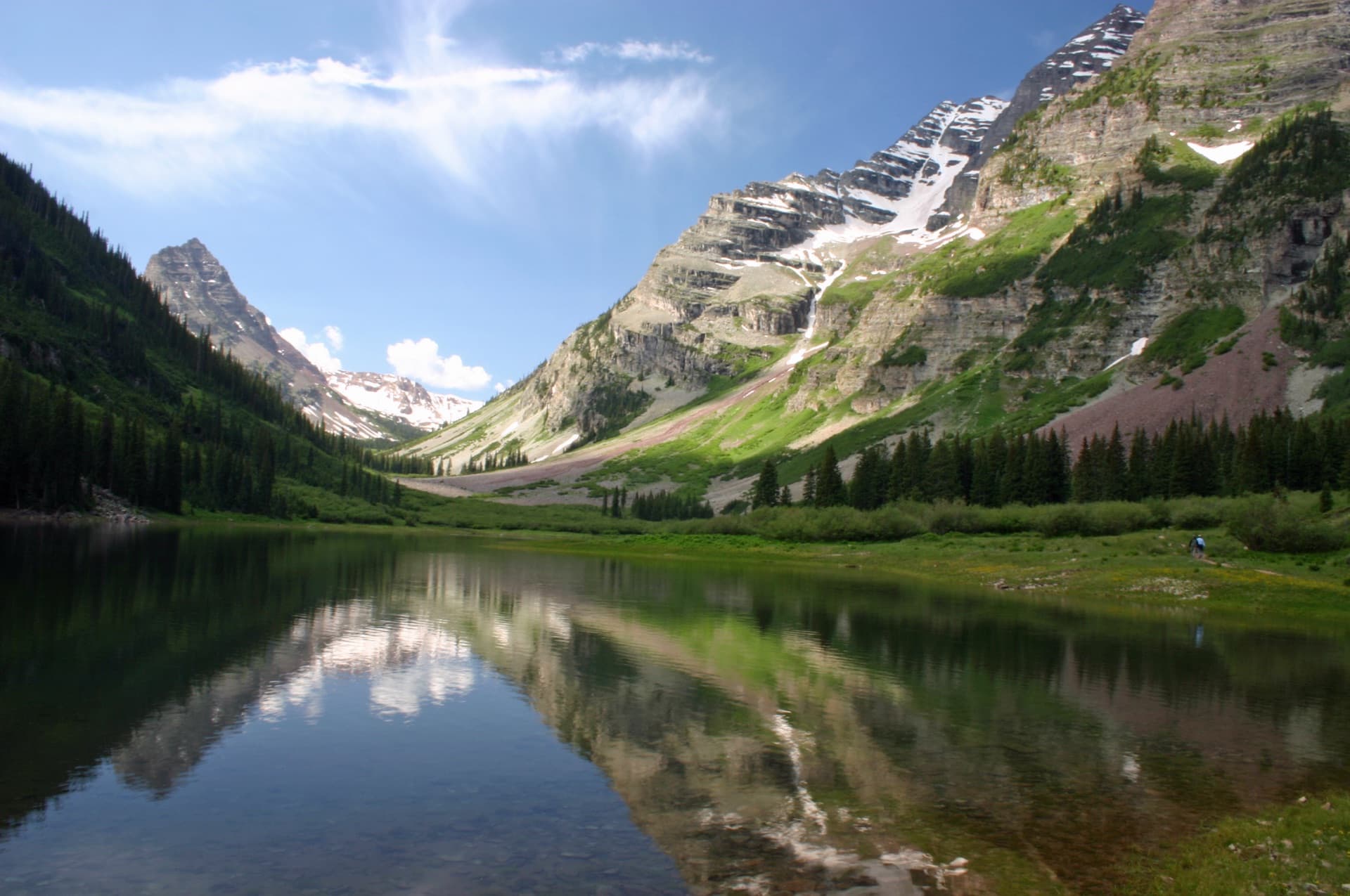
A big alpine lake with Snowmass Mountain and Hagerman Peak closing the far end, and a boulder field you cross to get around it. No fire ring anywhere, because the elevation rule bans them, so it is stoves and headlamps and an early night.
Snowmass Lake (above 10,800') hike highlights
- Thirteen groups a night: the biggest quota in the wilderness, and still competitive
- Choose-your-own established campsite rather than an assigned pad, 70 big steps from trails and water
- No campfires at all, because the lake is above 10,800 feet
- Overlap with Four Pass Loop parties, who use this zone as a standard night
- No toilets anywhere
How hard the Snowmass Lake (above 10,800') hike is
- Physical DemandFitness and endurance required4/5
- Technical SkillClimbing, scrambling, or specialized skills1/5
- Exposure RiskSteep dropoffs and fall potential3/5
- NavigationRoute finding and trail clarity2/5
- CommitmentDifficulty of bailing out mid-route3/5
Best for: Backpackers who want the signature Elk Range lake camp and are willing to carry a stove instead of expecting a fire.
Recommended experience: Prior backpacking at altitude, and comfort on boulder-field trail.
Not recommended for: Anyone counting on a campfire, or expecting solitude on a July weekend when Four Pass Loop parties are cycling through.
When to hike Snowmass Lake (above 10,800')
Best time to visit
July through September, the window USFS names. From early October to late June the campsites, trails and passes are snow-covered, avalanche hazard exists and route finding is difficult.
- Peak
- July through September
- Shoulder
- Late June and early October
Spring
USFS is blunt: from early October to late June campsites, trails and mountain passes are snow-covered and trailheads may be inaccessible. Avalanche hazards exist and snow makes route finding difficult.
Crowd level · low
- Advantage: Permits are available
- Advantage: Real solitude
- Challenge: Snow camping
- Challenge: Avalanche hazard
- Challenge: Trailheads may not be drivable
Summer
July through September is the season USFS names as the best time to visit, and it is when the zone quota actually binds.
Crowd level · extreme
- Advantage: Passes clear
- Advantage: Wildflowers through July
- Advantage: Long days
- Challenge: Zone quota is the whole constraint
- Challenge: Daily afternoon storms
- Challenge: Maroon Scenic Area needs its own parking or bus reservation
Fall
Aspen colour in late September, then the season closes hard in early October when snow returns.
Crowd level · high
- Advantage: The aspens
- Advantage: Cool hiking
- Advantage: Fewer storms
- Challenge: Short window before snow
- Challenge: Cold nights
- Challenge: Early storms can close passes
Winter
Permits are required year round, but the wilderness is a snow-travel objective from October to June.
Crowd level · low
- Advantage: Permits available
- Advantage: Complete solitude
- Challenge: Avalanche terrain
- Challenge: Trailhead access
- Challenge: Winter camping at altitude
Weather Forecast
Trailhead (5,000 ft)
Backcountry Tips
- Tomorrow: 66% chance of precipitation. Pack rain gear.
Today
46°
35°
Wed
43°
35°
66%
Thu
52°
34°
Fri
59°
35°
Sat
58°
37°
Sun
59°
36°
Mon
58°
38°
Snowmass Lake (above 10,800') photography guide
Golden Hour
Evening light on Snowmass Mountain and Hagerman Peak across the water.
Best Light
Dead-calm mornings, when the lake gives you the whole wall twice.
Beat the Crowds
Thirteen groups is a lot for this wilderness. Camp at the far end of the zone from where the loop traffic drops packs, and go midweek.
Classic Shots
- Snowmass Mountain reflected in the lake at dawn
- The boulder field along the north shore
- A stove-only camp above 10,800 feet
- Snowmass Creek valley on the walk in
Snowmass Lake (above 10,800') rules, gear and safety
Gear checklist
Required- An IGBC-approved bear canister or Ursack. This is enforced, not encouraged
- A stove. Campfires are banned at every designated site in this zone
- A WAG bag or a trowel, because there are no toilets anywhere in this wilderness
- A printed permit and photo ID
- Water treatment
Recommended gear
- Trekking poles for the boulder field on the north shore
- An extra insulating layer, since there is no fire at this elevation
- A tarp for the afternoon storms
Rules & regulations
- 01Eleven of the thirteen Snowmass Lake permits are for 1-4 people; two are for 5-10
- 02Group size is limited to the maximum number of persons allowable at the campsite, with total group size limited to 10 if multiple campsites are reserved
- 03This zone does not assign campsites. Select an established site at least 70 big steps from trails and water
- 04Campfires are prohibited above 10,800 feet, including Snowmass Lake
- 05Permits are limited to two per person per calendar year, and two permits cannot overlap the same night
- 06Maximum length of stay per permit is seven nights
- 07Food, trash and any scented item must be stored in an IGBC-approved bear-resistant container. USFS states that visitors without one will be ticketed and required to leave
- 08There are no toilets in the Maroon Bells-Snowmass Wilderness. WAG bags are highly recommended but not required and must be packed out; otherwise dig a cat hole six to eight inches deep at least 200 feet from water, camp and trails
- 09Dogs must be on leash
- 10Permits are only available through Recreation.gov. Ranger stations will not issue them
- 11The permit must be printed and carried with photo ID, and can be printed as early as 14 days before your date
Hazards & considerations
- Altitude. This is Colorado high country and the campsites sit well above most people's baseline
- Afternoon thunderstorms, which arrive on schedule in July and August and have nowhere to hide from
- Snow on the passes and at the campsites from early October to late June, with avalanche hazard and difficult route finding
- Black bears: the reason USFS writes the canister rule as a ticketable offence
- Trailheads that may be inaccessible to vehicles outside the July-to-September window
Safety & planning
Emergency Info
Emergency contacts, ranger station locations, and satellite communicator tips for Snowmass Lake (above 10,800').
Food Storage
Bear canister requirements, approved container lists, and rental locations for this permit.
Gear Checklist: Required and recommended gear for Snowmass Lake (above 10,800') · Shuttle Services: Trailhead transportation options · Guide Services: Experienced wilderness guides
Some links may be affiliate links. Purchases support PermitSnag at no extra cost to you.
Snowmass Lake (above 10,800') FAQ
How many permits per night are issued for Snowmass Lake in the Maroon Bells?
Thirteen groups per night, which is the largest zone allocation in the Maroon Bells-Snowmass Wilderness. USFS splits it into 11 permits for 1-4 people and 2 permits for 5-10 people.
Can I have a campfire at Snowmass Lake?
No. USFS prohibits campfires above 10,800 feet in the Maroon Bells-Snowmass Wilderness and names Snowmass Lake specifically. Bring a stove.
Does the Snowmass Lake permit assign me a campsite?
No. Only the Conundrum Hot Springs, Crater Lake and Capitol Lake zones assign campsites. In every other zone, including Snowmass Lake, USFS asks you to select an established campsite within the zone that is 70 big steps away from trails and water.
What is the group size limit at Snowmass Lake?
Group size is limited to the maximum number of persons allowable at the campsite, with total group size limited to 10 if multiple campsites are reserved. Of the 13 permits USFS issues per night here, 11 are for 1-4 people and 2 are for 5-10.
Do I need a bear canister for the Maroon Bells-Snowmass Wilderness?
Yes. USFS requires food, trash and any scented item to be stored in an IGBC-approved bear-resistant container, and states that visitors without one will be ticketed and required to leave. Local retailers in Aspen rent and sell approved containers.
Snowmass Lake (above 10,800') trail conditions and trip reports
Trail Conditions
No active conditions reported
Sign in to report trail conditions.
Questions
No questions yet
Be the first to ask about Snowmass Lake (above 10,800').
Trip Reports
Write ReportNo trip reports yet
Be the first to share your experience at Snowmass Lake (above 10,800').
Write the First ReportAlternatives to a Snowmass Lake (above 10,800') permit
- Same AreaPermit required
Four Pass Loop Permit
The 26-mile loop over four passes, booked as a zone-by-zone itinerary through the same Recreation.gov permit.
Tradeoffs
Far more competitive and requires stringing several zones together on consecutive nights.
- Same AreaPermit required
Conundrum Hot Springs
Twenty groups a night at designated campsites, with the hot springs at the top of the valley.
Tradeoffs
Campsites cap between two and six people, dogs are banned outright, and it is the most sought-after zone in the wilderness.
- Same AreaPermit required
Crater Lake
Eleven groups a night in the zone closest to Maroon Lake, with ten designated campsites for 1-4 people and one, campsite #7, that takes 5-10.
Tradeoffs
The shortest walk in of any Maroon Bells zone, which is exactly why it goes first.
Where to stay near Snowmass Lake (above 10,800')
- Maroon Bells Amphitheatre campgroundWhite River National Forest
- Gothic campgroundGrand Mesa, Uncompahgre and Gunnison National Forest
- East Maroon Portal Picnic SiteWhite River National Forest
- All Colorado campgrounds
Plan the full trip, not just the permit
Build your full itinerary start to finish
Add your dates and get a day-by-day plan: what needs a permit, what gear to bring, and one link to share with your whole group to coordinate every step.
No permit needed to start
One tick helps us more than you’d think
Google lets you pick the sites it highlights for you. Add PermitSnag and our permit pages get marked as one of yours in AI Overviews and AI Mode.
Takes less than a minute.