Trailhead information
String Lake
PrimaryNorth end of the Jenny Lake road. NPS lists String Lake as the finish of the Teton Crest Trail and it is the start of the 19.0-mile Cascade Canyon/Paintbrush Canyon loop.
- No restrooms
- No water
Grand Teton National Park · Wyoming
The park-wide overnight permit for camping anywhere in Grand Teton's backcountry, from lakeshore sites to high mountain zones.
Get an alert when a spot opens in your GTNP Backcountry zone.
Source: recreation.gov
70% of the openings our scanner caught on GTNP Backcountry were gone within 10 minutes.
As of September 2026, GTNP Backcountry in Grand Teton National Park, Wyoming requires a permit issued via reservation. GTNP Backcountry is a high-demand permit, rating 8/10 on PermitSnag's demand index. Cancelled GTNP Backcountry permits are re-released on the booking system, and PermitSnag alerts you the moment one opens. The permit season for GTNP Backcountry runs May 1 through October 31.
Sign up at Recreation.gov if you don't have an account. Have your payment info ready.
Permits release on a rolling basis. Check the release time for your dates.
Log in a few minutes early. Have your dates, group size, and payment ready to go.
If your dates are sold out, people cancel all the time. Set up PermitSnag alerts to catch openings instantly.
More on GTNP Backcountry: Live availability activityWhen GTNP Backcountry permits open upDo I need a Grand Teton Backcountry permit?
GTNP Backcountry permit fee: $20 permit fee plus $7 per person, per night.
Where NPS starts its Teton Crest Trail mileage, outside the park boundary.
A Mountain Camping Zone on the crest above Granite Canyon.
A Mountain Camping Zone on permit 4675342, between the Death Canyon and Fox Creek Pass zones in Recreation.gov's own ordering.
Alpine lake on the west side of the divide, near Alaska Basin.
Small glacier just off the crest near Hurricane Pass.
Cirque lake at the head of Cascade Canyon's north fork.
A Mountain Camping Zone in upper Paintbrush Canyon.
Where NPS ends the Teton Crest Trail, and the start of the Paintbrush-Cascade loop.
One permit unlocks a whole range. Sleep beneath the Grand, wake up on a lakeshore, or camp high in a mountain zone where you pick your own spot.
Grand Teton runs one park-wide backcountry permit that covers every overnight zone, from paddle-in lakeshore sites on Jackson Lake and Leigh Lake to the high Mountain Camping Zones below the peaks. About one-third of sites open for advance reservation on Recreation.gov, and the rest are walk-up at the visitor centers the day before you leave.
There is no single route on this permit. What you book is a place to sleep, and Grand Teton sells three very different kinds of place. On Jackson Lake and Leigh Lake the sites are numbered and fixed. In the canyons and up on the crest you book a Mountain Camping Zone instead of a site, and you choose your own ground inside it, at least 200 feet back from water and the trail. In the Pristine Sites and the Technical Climbing Sites you are booking a spot under a route rather than a campsite.
The long routes string those zones together. NPS describes the Teton Crest Trail as a 39-mile point-to-point that starts outside the park at Phillips Pass and finishes at String Lake, with 9,000 feet of elevation gain. Shorter loops out of the same zones are published too: Cascade Canyon to Paintbrush Canyon is 19.0 miles, Granite Canyon to Open Canyon is 20.2 miles, and the Tram to Death Canyon loop is 21.9 miles. Build the itinerary out of zones first and the mileage follows.
The permit itself is split. NPS says about one third of backcountry camping permits are available for advance reservation, opening at 8 a.m. MST on January 7, 2026 for the May 1 to October 31 season, and the rest are held for walk-up.
Grand Teton packs more vertical drama into a small footprint than almost anywhere in the lower 48. The backcountry permit is your ticket to camp inside that skyline instead of driving out to a hotel each night.
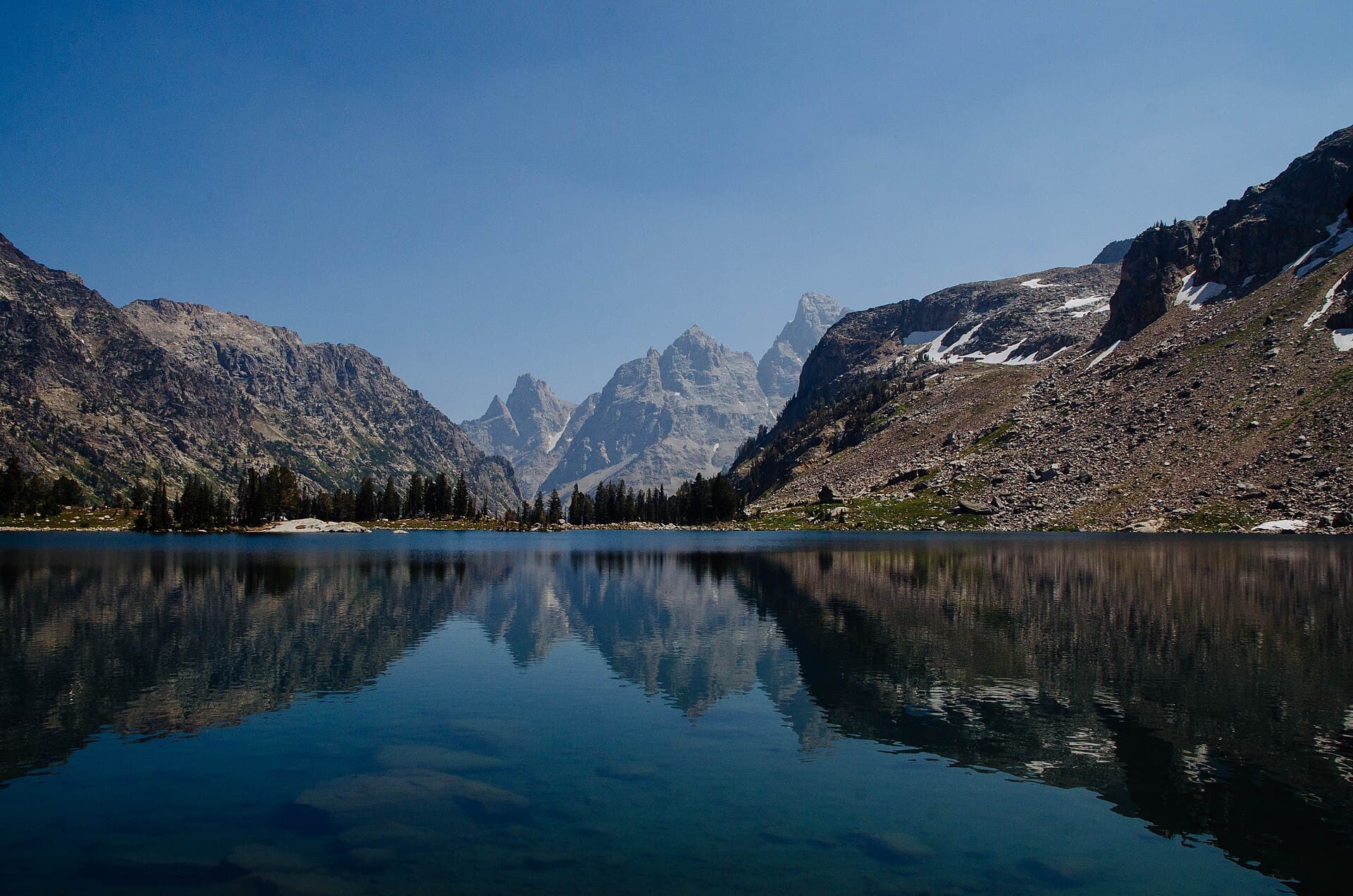
At a Mountain Camping Zone site the peaks feel close enough to touch. Down at Leigh Lake the water goes glassy at dusk and the whole range flips upside down in the reflection.
Best for: Hikers of moderate fitness willing to put in the effort.
Recommended experience: Basic hiking experience. Start with shorter trails if new to hiking.
Trailhead information
North end of the Jenny Lake road. NPS lists String Lake as the finish of the Teton Crest Trail and it is the start of the 19.0-mile Cascade Canyon/Paintbrush Canyon loop.
Trailhead information
Access to the Death Canyon and Death Canyon Shelf camping zones and, by way of Static Peak Divide, the 25.8-mile Cascade Canyon/Death Canyon loop.
Trailhead information
Valley-floor start for the Granite and Open Canyon zones. NPS publishes the Granite Canyon/Open Canyon loop at 20.2 miles and the Granite Canyon/Paintbrush Canyon route at 38.6 miles.
Trailhead information
NPS measures Tram to Granite Canyon via Marion Lake at 15.0 miles and Tram to Cascade Canyon at 28.6 miles.
Trailhead information
Cascade Canyon access. NPS gives the Cascade Canyon/Death Canyon loop as 25.8 miles, or 23.4 miles with the ferry option.
Mid-July through mid-September. Passes clear of snow by late July most years and lakeshore sites open earlier in the season.
Trailhead (5,000 ft)
Today
62°
35°
Wed
66°
42°
Thu
65°
42°
Fri
66°
46°
Sat
69°
45°
Sun
72°
44°
Mon
70°
52°
First light hits the east faces, so an east-side camp in Paintbrush or Cascade Canyon puts the range in front of you at sunrise. West of the divide, Sunset Lake and Alaska Basin hold warm light late.
Morning for the peaks from the park side. Evening for the lakes, when Leigh, String and Jackson go still and the range reflects.
Emergency contacts, ranger station locations, and satellite communicator tips for GTNP Backcountry.
Bear canister requirements, approved container lists, and rental locations for this permit.
Gear Checklist: Required and recommended gear for GTNP Backcountry · Shuttle Services: Trailhead transportation options · Guide Services: Experienced wilderness guides
Some links may be affiliate links. Purchases support PermitSnag at no extra cost to you.
About a third of sites are reservable in advance on Recreation.gov starting January 7 at 8 a.m. MST for the May to October season, up to 2 days before your trip. The rest are first come, first served as walk-up permits at a park visitor center one day before you leave.
A flat $20 permit fee plus $7 per person, per night. The nightly fee is refundable if you cancel 5 or more days before your start date. The $20 permit fee is non-refundable.
Yes. An approved bear-resistant food canister is required for all backcountry camping in Grand Teton National Park. You can rent one at the park if you do not own one.
A standard permit covers up to 6 people. Groups of 7 to 12 must reserve designated backcountry group sites and cannot split into smaller parties camping in the same zone.
No active conditions reported
Sign in to report trail conditions.
No questions yet
Be the first to ask about GTNP Backcountry.
The signature multi-day traverse of the range, booked on this same permit through the mountain camping zones.
One set route rather than a build-your-own itinerary, and the marquee zones fill first.
A classic two to three night loop over Paintbrush Divide out of the String Lake trailhead.
Snow lingers on Paintbrush Divide into July most years.
Remote camping on the quieter west side of the range with easier permit odds.
Farther from the Teton skyline the east-side zones are known for.
Build your full itinerary start to finish
Add your dates and get a day-by-day plan: what needs a permit, what gear to bring, and one link to share with your whole group to coordinate every step.
No permit needed to start
Google lets you pick the sites it highlights for you. Add PermitSnag and our permit pages get marked as one of yours in AI Overviews and AI Mode.
Takes less than a minute.